Every suicide is a tragedy. Behind every statistic is a person, a family, friends, colleagues and a workplace community affected by loss. In recent years, growing attention has been placed on the relationship between work, mental health and suicide risk — and the data emerging from the UK paints a concerning picture for several industries.
While suicide is complex and rarely caused by one single factor, evidence from the UK’s Office for National Statistics (ONS) continues to show that certain occupations experience significantly higher suicide rates than others. These findings reinforce the importance of workplace wellbeing, early intervention, supportive leadership and creating environments where people feel able to ask for help.
At We Are Wellbeing, we believe organisations have a powerful role to play in helping reduce stigma, improve mental health awareness and create healthier workplace cultures.
What Does the UK Data Show?
The ONS regularly analyses suicide data by occupation across England and Wales. Rather than grouping people purely by industry sector, the research looks at occupational categories and identifies where suicide risk appears to be significantly higher than the national average.
Several occupations consistently emerge as higher-risk groups.
Construction Industry
The construction industry is perhaps the most widely discussed example in the UK. Research has repeatedly shown elevated suicide rates among construction workers, particularly among labourers and skilled trades.
Construction workers often face:
- Long working hours
- Physically demanding work
- Financial uncertainty
- Job insecurity
- Time away from family
- Subcontractor pressures
- A traditionally male-dominated culture where discussing mental health may feel difficult
Many industry campaigns now report that suicide kills more construction workers than physical accidents on site.
This has led to a growing movement across the construction sector to improve mental health awareness, train managers, increase signposting support and normalise conversations around stress, burnout and emotional wellbeing.
Agriculture and Farming
Farming and agricultural work has also consistently shown elevated suicide risk within UK data.
Farming can involve:
- Isolation and lone working
- Financial pressures
- Unpredictable weather impacts
- Long hours
- High responsibility
- Limited access to support networks
For many individuals in agriculture, the boundaries between work and personal life are also blurred, which can make stress harder to escape.
Care Workers and Healthcare Professionals
Care workers, nurses and healthcare staff often work in emotionally demanding environments where they regularly support people in distress.
Common workplace pressures may include:
- Emotional exhaustion
- Shift work
- Compassion fatigue
- Staff shortages
- High workloads
- Exposure to trauma or grief
Healthcare professionals are often highly skilled at caring for others while struggling to prioritise their own wellbeing. Many organisations are now recognising the importance of psychological support, supervision, peer support networks and wellbeing education for frontline teams.
Creative and Media Industries
People working within artistic, media and creative professions have also been identified as being at increased risk in some UK studies.
Potential contributing factors may include:
- Financial instability
- Freelance insecurity
- Irregular work patterns
- Performance pressure
- Public scrutiny
- Isolation
- Lack of routine
The music industry in particular has received growing attention following recent research suggesting musicians experience some of the highest suicide rates among occupational groups in England.
Why Might Some Occupations Be More Vulnerable?
It is important to recognise that occupation alone does not cause suicide. Suicide is complex and influenced by multiple factors including mental health, trauma, finances, relationships, physical health and social circumstances.
However, workplace conditions can contribute to stress levels and psychological strain.
Research suggests several common themes may increase vulnerability in certain sectors:
- Poor work-life balance
- Financial instability
- Job insecurity
- Workplace bullying or poor management
- High workloads
- Isolation
- Exposure to trauma
- Fatigue and burnout
- Substance misuse
- Lack of psychological safety
- Limited access to support
- Stigma around mental health
Male-dominated industries can face additional challenges where cultural expectations around “being strong” discourage help-seeking behaviour.
Why Workplace Wellbeing Matters
Organisations cannot control every aspect of a person’s life, but workplaces can make a significant difference in creating safer, healthier and more supportive environments.
A positive workplace culture can help:
- Reduce stigma around mental health
- Encourage early help-seeking
- Improve awareness of stress and burnout
- Increase psychological safety
- Strengthen social connection
- Improve manager confidence
- Promote healthier behaviours
- Support earlier intervention
Importantly, wellbeing initiatives should not simply focus on crisis response. Prevention matters.
Employees are far more likely to speak up early when:
- Managers are approachable
- Mental health conversations are normalised
- Support pathways are clear
- Leaders role-model healthy behaviours
- Workloads are managed appropriately
- Employees feel listened to
The Importance of Manager Training
Line managers often play a critical role in recognising early signs that someone may be struggling.
Changes in behaviour may include:
- Withdrawal
- Irritability
- Reduced performance
- Increased absence
- Fatigue
- Loss of motivation
- Emotional changes
- Increased risk-taking
- Presenteeism
Many managers want to support their teams but simply lack confidence or training.
This is why mental health awareness training, wellbeing champion programmes and psychologically informed leadership development are becoming increasingly important across UK workplaces.
Creating a Culture of Psychological Safety
Psychological safety refers to creating an environment where people feel safe to speak honestly without fear of judgement or negative consequences.
In psychologically safe workplaces, employees are more likely to:
- Ask for help
- Share concerns
- Report stress early
- Support one another
- Speak openly about mental health
Small cultural changes can have a major impact.
Simple actions include:
- Regular wellbeing conversations
- Visible leadership support
- Signposting to support services
- Promoting Employee Assistance Programmes (EAPs)
- Encouraging breaks and recovery
- Supporting flexible working where possible
- Training wellbeing champions
- Encouraging peer support
A Shared Responsibility
Reducing suicide risk is not solely the responsibility of one individual, manager or department. It requires collective responsibility across organisations, leaders, managers and employees themselves.
Workplaces do not need to become mental health experts — but they do need to become environments where people feel supported, respected and able to access help when needed.
As awareness continues to grow across the UK, more organisations are recognising that wellbeing is not simply a “nice to have.” It is a fundamental part of creating sustainable, healthy and productive workplaces.
Support Is Available
If you or someone you know is struggling, support is available. Organisations such as Samaritans provide confidential emotional support 24 hours a day in the UK and Ireland by calling 116 123.
At We Are Wellbeing, we support organisations through:
- Mental Health Awareness Training
- Manager Wellbeing Training
- Wellbeing Champions Training
- Workplace Wellbeing Strategy
- Employee Wellbeing Webinars
- Health & Wellbeing Campaigns
Creating healthier workplaces can help create healthier people — and sometimes, those conversations really can save lives.
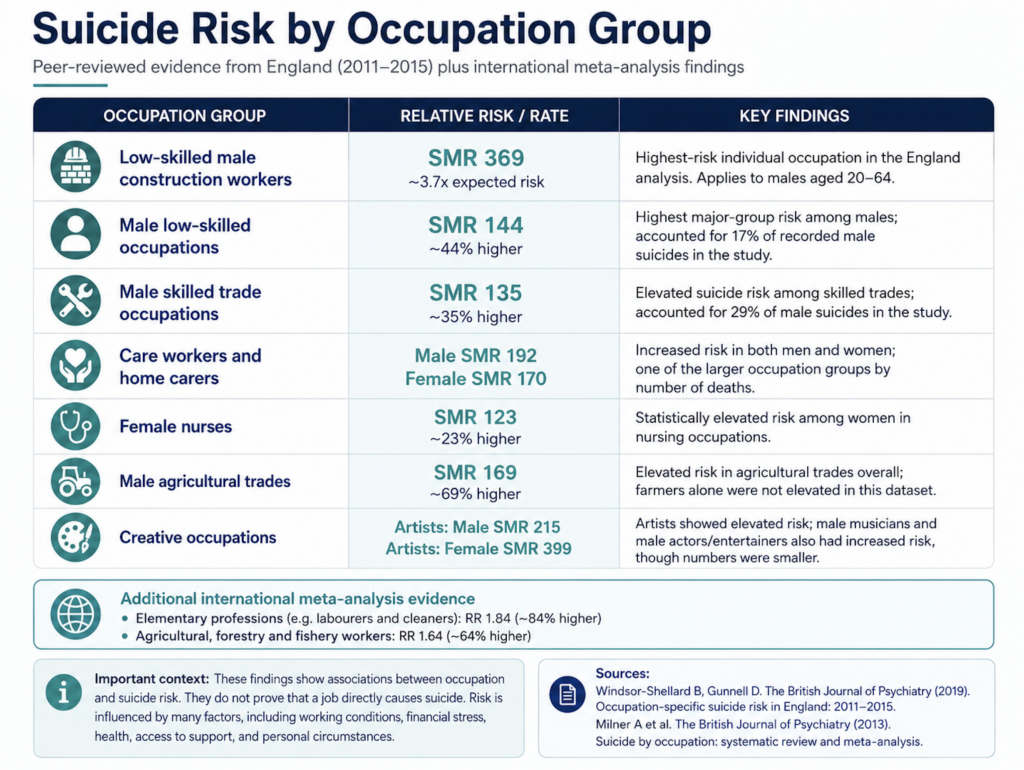
SMR = Standardised Mortality Ratio.
It compares the number of deaths observed in a specific group with the number that would be expected if that group had the same death rate as a reference population, after adjusting for things like age and sex.
In simple terms:
SMR 100 = same as expected / average risk
SMR 123 = 23% higher than expected
SMR 144 = 44% higher than expected
SMR 192 = 92% higher than expected
SMR 369 = 269% higher than expected, or about 3.7 times expected risk
So on the poster, “SMR 369” for low-skilled male construction workers means the suicide mortality rate was around 3.7 times higher than expected in that ONS-linked peer-reviewed analysis. (Cambridge University Press & Assessment)