Workplace wellbeing is now a strategic priority for many organisations, but one challenge remains: how do you measure whether your workplace wellbeing strategy is actually working?
Businesses are investing more in employee wellbeing programmes, health initiatives and preventative support, yet many still struggle to demonstrate measurable outcomes or a clear return on investment.
The solution is to use data more effectively.
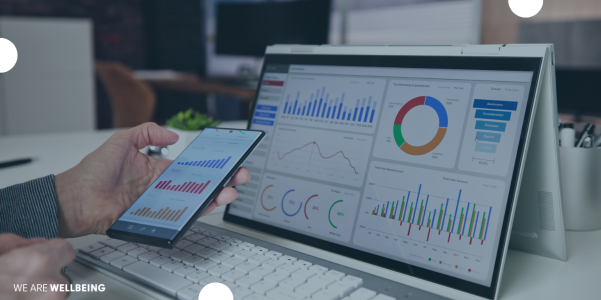
By combining employee health screening data with workplace wellbeing survey data, organisations can build a much clearer picture of workforce health, identify the areas that require the greatest attention and measure improvements over time.
This approach transforms workplace wellbeing from a collection of activities into a measurable business strategy.
Why Measuring Workplace Wellbeing Matters
A successful workplace wellbeing strategy should do more than increase engagement with wellbeing activities.
It should help organisations understand whether employee health, wellbeing and workplace experience are improving.
Without meaningful measurement, businesses risk investing in initiatives based on assumptions rather than evidence.
Measuring workplace wellbeing allows organisations to:
- Identify key employee health and wellbeing risks
- Establish measurable wellbeing benchmarks
- Target resources where they are most needed
- Track changes over time
- Evaluate the effectiveness of workplace wellbeing initiatives
- Strengthen the business case for continued investment
Most importantly, it allows HR and leadership teams to demonstrate the impact of their workplace wellbeing strategy.
Using Employee Health Screening Data
Workplace health screenings provide objective information about employee health.
Depending on the health screening programme, this can include measures such as:
- Blood pressure
- Cholesterol
- Blood glucose
- BMI and body composition
- Cardiovascular risk
- Lifestyle behaviours
- Physical activity levels
Individual health screening results should always remain confidential, but aggregated and anonymised workforce data can provide valuable insight.
For example, a business may discover that a significant proportion of employees have elevated blood pressure or increased cardiovascular risk.
This information can help the organisation identify preventative health priorities and shape its workplace wellbeing programme accordingly.
Rather than offering generic wellbeing initiatives, the organisation can focus investment on areas where the data demonstrates a genuine need.
Combining Health Screening Data with Wellbeing Survey Data
Health screening data provides an important picture of physical health, but it does not explain everything.
This is why employee wellbeing surveys are equally important.
A workplace wellbeing survey can measure employee perceptions and experiences across areas such as:
- Stress
- Mental wellbeing
- Sleep
- Energy
- Workload
- Financial wellbeing
- Physical activity
- Nutrition
- Relationships
- Management support
- Workplace culture
When health screening data and wellbeing survey data are analysed together, organisations gain a much more complete understanding of employee wellbeing.
For example, health screening results may show increased cardiovascular risk while wellbeing survey results identify high levels of stress, poor sleep and low physical activity.
Together, these findings can help an organisation develop a targeted strategy focused on stress management, sleep, movement and preventative health.
Establish a Workplace Wellbeing Baseline
One of the most important steps in making workplace wellbeing measurable is establishing a baseline.
Before launching new initiatives, organisations should understand the current health and wellbeing of their workforce.
Health screening and wellbeing survey results provide the starting point.
Businesses can then establish measurable workplace wellbeing KPIs, such as:
- Reducing the percentage of employees reporting high stress
- Improving average employee wellbeing scores
- Increasing physical activity levels
- Improving sleep quality
- Reducing identified health risks
- Increasing employee awareness of personal health
- Improving perceptions of workplace support
This allows organisations to move away from vague objectives such as “improve wellbeing” towards specific, measurable outcomes.
Measure Outcomes, Not Just Participation
One of the most common mistakes in workplace wellbeing is relying too heavily on participation data.
Knowing that 150 employees attended a webinar or 300 employees completed a health screening is useful, but participation does not necessarily demonstrate impact.
The more important question is:
What changed?
Organisations should repeat health screenings and employee wellbeing surveys at appropriate intervals and compare the results against the original baseline.
Has employee stress decreased?
Has sleep improved?
Are employees more physically active?
Have particular health risks reduced?
Do employees feel better supported by their organisation?
This repeated measurement creates a much stronger picture of the effectiveness of a workplace wellbeing programme.
Demonstrating Workplace Wellbeing ROI
To demonstrate workplace wellbeing return on investment, organisations should consider wellbeing data alongside broader business metrics.
These may include:
- Sickness absence
- Employee turnover
- Retention
- Engagement
- Productivity
- Employee assistance programme usage
- Occupational health referrals
- Performance indicators
It is important not to assume that every improvement is directly caused by a wellbeing intervention.
However, organisations can look for trends and relationships across multiple datasets.
For example, if employee stress scores improve at the same time as stress-related absence decreases, this can provide stronger evidence that wellbeing activity may be having a positive impact.
Likewise, improvements in employee wellbeing alongside higher engagement and improved retention can strengthen the business case for continued investment.
This is how workplace wellbeing begins to move from being viewed as a cost to being recognised as a measurable investment.
Create a Continuous Workplace Wellbeing Strategy
The most effective workplace wellbeing programmes are not one-off campaigns.
They operate as a continuous cycle:
Measure. Analyse. Prioritise. Intervene. Re-measure. Improve.
Health screening data identifies physical health risks.
Wellbeing survey data provides insight into employee experience.
Business metrics demonstrate organisational impact.
When these datasets are combined, businesses can make more informed decisions about where to invest, what to change and how to measure success.
Ultimately, the goal is not simply to demonstrate that wellbeing activities have taken place.
It is to demonstrate that employee health and wellbeing have meaningfully improved.
Make Your Workplace Wellbeing Strategy Measurable
At We Are Wellbeing, we help organisations move beyond one-off wellbeing initiatives and build evidence-led workplace wellbeing strategies.
Through employee health screenings, wellbeing surveys, strategic wellbeing support, workshops, webinars and targeted interventions, we help businesses identify workforce health risks, establish measurable benchmarks and track progress over time.
If you want to understand what your workforce really needs and demonstrate the impact of your wellbeing investment, we can help you turn your health and wellbeing data into a clear, measurable strategy.
Speak to We Are Wellbeing today to explore how health screening and employee wellbeing data can help you build a healthier workforce and demonstrate meaningful return on investment.